
Seoul Scissors · Brooklyn
Japanese Hair Straightening in Brooklyn
The Treatment That Ends the Fight With Frizz
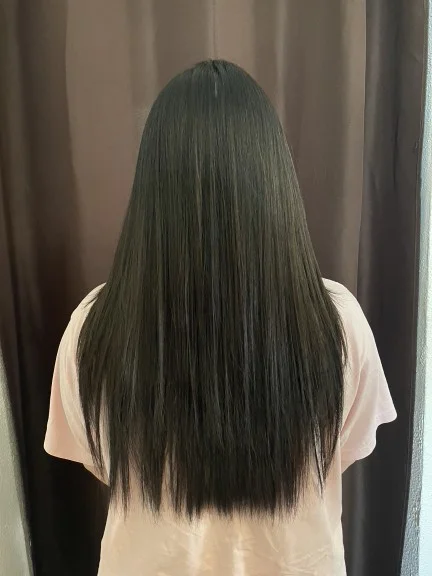
Japanese hair straightening — the magic straight perm — transforms frizzy, wavy, or unruly hair into sleek, glass-like straightness that lasts for months. It isn’t a temporary smoothing that fades in a few weeks. It’s a thermal reconditioning that reshapes the hair itself, done here with Seoul- and Japan-trained technique and healthy-hair-first care.
If you’ve spent years fighting frizz — flat-ironing every morning, watching humidity undo an hour of work in ten minutes, avoiding rain and gyms and pools because of what they do to your hair — this is the service built specifically to end that cycle. Not by masking the problem, but by permanently restructuring the hair that’s causing it.
With more than 25 years behind the chair and specific training in this technique beyond her Seoul foundation, Nicole starts every straightening consultation with an honest look at your hair’s history before anything is promised.
Which One Is Right for You
Straightening vs. Digital Perm — Quick Answer
Opposite goals, equally lasting — the choice is about the hair you want, not which service is “better.”
Japanese Hair Straightening
From $400 · about 4 hours
For frizz, waves, and unruliness → glass-straight and lasting for months.
From $250 · 2–3 hours
For straight hair that wants waves → soft, heat-set movement.
If you’re still not sure which direction is right for your hair, that’s exactly what the consultation is for — there’s no wrong question to ask before deciding.
The Straightening Process — What to Expect
Consultation & hair history
(essential for this service):
Previous color, bleach, or smoothing treatments all matter. Your hair's condition determines whether straightening is safe today — and if it isn't, you'll hear that honestly with a treatment plan instead.
The treatment (about 4 hours):
Solution applied section by section, processed, then each strand flat-ironed with precision heat to lock the new shape, followed by a neutralizer to set it in place.
The reveal & aftercare lesson:
The glass-smooth result, plus the rules that protect it — when you can wash, what to avoid, how to keep it glossy for its full life.
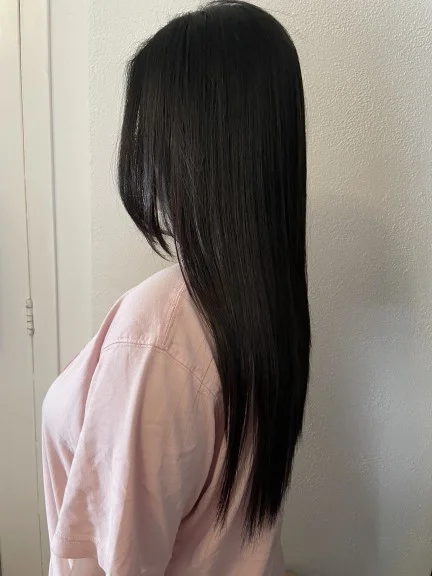
Real Straightening Results From the Chair
Every photo below is my own work, taken here in the Brooklyn studio.


The Basics
What Is Japanese Hair Straightening, Really?
Known in Japan as thermal reconditioning and to clients as the “magic straight perm,” this treatment uses a chemical solution plus precisely controlled flat-iron heat to restructure the hair’s internal bonds into a straight configuration. It doesn’t coat or mask the hair the way a smoothing spray or a keratin-style treatment does. The hair itself is chemically and physically reshaped — straight, glossy, and smooth until it grows out.
That distinction matters if you’ve tried smoothing treatments before and been disappointed when they faded in a few washes or reverted in humidity. Those treatments work on the surface. This one works on the structure. New regrowth comes in at the root with your natural texture over the following months, while the treated lengths stay sleek — which is why most clients return for a root touch-up rather than a full re-treatment.
Signs
Is This the Treatment You've Been Putting Off?
If any of this sounds familiar, you’re the reason this service exists:
You flat-iron your hair most mornings just to leave the house
Humidity or rain undoes your style within the hour
You've avoided the gym, the pool, or a rainy commute because of what it does to your hair
Your hair frizzes or reverts a few hours after a blowout
You've tried smoothing treatments before and they faded faster than promised
You spend real money and real time on products that only manage frizz, never solve it
You've thought about this treatment for a while but keep talking yourself out of it
If you recognized more than one of those, that’s usually a sign it’s worth having the consultation — not committing to anything, just finding out honestly whether your hair is a candidate.
Diagnosis
Straightening, Smoothing & Relaxing Are Not the Same Thing
A lot of the hesitation around this service comes from confusing it with something else. They are not interchangeable.
Japanese Hair Straightening
A permanent, structural change using a specific chemical process and controlled heat. The result lasts until the hair grows out — it doesn't fade or wash out.
Keratin & Smoothing Treatments
Temporary coating treatments that reduce frizz and add shine for a period of weeks, then fade with washing. They don't permanently change the hair's structure. (Seoul Scissors doesn't offer keratin treatments — if that's what you've had before and been let down by, that's part of why this service works differently.)
Chemical Relaxers
Designed for very different hair textures and typically used to loosen tight curl patterns. A different chemistry, a different process, and not something offered here.
If you’ve been disappointed by a smoothing treatment before, that disappointment makes sense — it was never built to do what Japanese straightening does.
Color & Straightening
Can I Get This If My Hair Is Colored?
Usually, yes — color that simply deposits pigment is generally compatible with straightening, with a condition check first. Bleached or heavily lightened hair is a different story: the combination of straightening chemistry and compromised, porous hair is too risky, and you’ll be told that honestly rather than talked into it. If your hair has been colored and you’re not sure where it falls, bring your full color history to the consultation and Nicole will tell you plainly where you stand.
Chemical History
What If I've Had a Perm, Relaxer, or Smoothing Treatment Before?
Hair that’s already been chemically processed needs a full evaluation before straightening — not because it’s automatically disqualified, but because overlapping chemical services on hair that’s already been altered carries real risk. A previous perm, a relaxer, or a prior smoothing treatment all change what’s currently happening inside the hair, and Nicole needs the complete picture before recommending anything. This is also why consultation and hair history come before any booking here — it’s the difference between a treatment that leaves your hair sleeker and one that damages it.
Common Concerns
Will My Hair Look Fake or Feel Stiff?
This is one of the most common hesitations, and it’s a fair one — a badly done straightening treatment can look flat and feel stiff. Done correctly, on hair that’s a genuine candidate, the result is glossy and smooth rather than plastic-looking, and it moves naturally rather than sitting stiff. The technique, the timing, and matching the treatment to your specific hair are what separate a natural result from an obviously “done” one — which is exactly why the consultation and hair-history check aren’t a formality here.
If your hair isn’t currently a strong candidate — because it’s bleached, over-processed, or already fragile — the honest answer may be to treat and stabilize it first, rather than straighten now and risk a result you won’t like. That answer costs Nicole a booking in the short term. It’s still the one you’ll get if it’s the right one for your hair.
Salon vs. Home
One Treatment vs. Years of Flat-Ironing
It’s worth doing the math on what you’re actually comparing. If you’re flat-ironing your hair most mornings, that’s real time — easily 15 to 30 minutes a day, which adds up to well over 100 hours a year — plus the cumulative heat damage of doing it yourself with a flat iron that isn’t professionally calibrated for the job. A single straightening treatment replaces that daily routine with an occasional root touch-up every 4 to 6 months.
Daily home styling = ongoing time, ongoing heat exposure, inconsistent results ·
One treatment = months of consistent results, far less daily heat
That doesn’t mean home styling disappears entirely — you’ll still want to protect and maintain the hair between appointments. But the daily fight against your hair’s natural texture is what this treatment is designed to remove.
Hair Type
Does It Work on Your Hair Type?
Straightening candidacy depends heavily on your starting point.
Fine Hair
Fine hair can be a good candidate, but it also shows processing errors more easily and needs a gentler hand with both the chemical solution and the heat.
Thick or Coarse Hair
Thicker, coarser hair often holds the straightened result exceptionally well and may need a stronger solution to fully process — this is one of the most common hair types for this treatment.
Wavy Hair
Wavy hair generally straightens beautifully and is one of the more predictable candidates for this service.
Curly Hair
Curly hair can be straightened, but tighter curl patterns require more careful technique and a longer, more thorough consultation to set expectations correctly.
Color-Treated Hair
Hair Depositing color is usually fine with a condition check; bleached or heavily lightened hair generally is not a safe candidate for this treatment.
Previously Chemically Processed Hair
Hair with a perm, relaxer, or prior smoothing treatment in its history needs a full evaluation of what's already been done before straightening is considered.
If you’re unsure which category you fall into, that uncertainty is normal — it’s what the consultation is for.
Honesty First
What Japanese Straightening Won't Fix
Part of doing this treatment responsibly is being upfront about its limits before you book, not after.
It won't repair hair that's already severely damaged — that needs treatment or a trim first
It won't undo split ends
It's a commitment, not a one-time fix — regrowth will need a root touch-up every 4 to 6 months
It's not reversible in the way a blowout is — this is a real chemical process, not a temporary style
It works best on healthy hair, not hair that's currently compromised from bleach or heavy processing
None of that makes it a bad treatment — it makes it a treatment worth doing right, on hair that’s genuinely ready for it.
Heat
How Heat Is Used — and Protected Against
Precisely controlled flat-iron heat is used during processing to lock the new shape without over-processing the hair
A neutralizer sets the new structure and helps protect the hair's condition afterward
Post-treatment, your hair generally needs far less daily heat styling than before — the sleekness is already built in
When you do use heat tools afterward, appropriate heat protection still matters, especially near the root as new growth comes in
The irony of this treatment is that it usually reduces your total heat exposure — replacing daily flat-ironing with an occasional touch-up.
History
Why Your Hair History Determines Everything Here
More than almost any other service at Seoul Scissors, Japanese straightening punishes shortcuts. Two people can walk in with hair that looks similarly frizzy and need completely different answers — one may have virgin hair that’s an excellent candidate, the other may have bleached or previously smoothed hair that makes straightening unsafe right now. The hair might look the same on the surface, but the chemistry underneath is not. This is why the consultation includes a real hair-history assessment rather than a quick yes — and why you may occasionally hear “not yet, let’s treat first” instead of a straight answer of yes.
Evaluation
How Nicole Evaluates Whether You're a Candidate
Before recommending straightening, Nicole considers things such as:
Hair texture and how much natural curl or frizz you're working with
Current condition, porosity, and elasticity
Complete chemical history — color, bleach, perms, previous smoothing treatments
How the hair responds to a strand test where needed
Your desired result and how much maintenance you're realistically willing to do
Your timeline and any upcoming events or other services
The goal is a straight yes, a straight no, or a clear plan to get you there — never a guess.
Timing
When to Book — and How Much Time to Set Aside
Set aside about 4 hours for the full appointment, including consultation, the treatment itself, and the aftercare lesson. Because the hair needs to settle into its new shape, you’ll also want to avoid washing, tying up, or clipping your hair for 48 to 72 hours afterward — so plan the appointment with a few low-key days on either side rather than booking it the morning of something important. After the initial treatment, most clients return for a root touch-up every 4 to 6 months as new growth comes in.
Honest Answers
Does It Damage Hair? Will It Make Hair Grow Faster?
Does Japanese straightening damage hair?
It's a significant chemical service — the honest answer, not a sales answer. Done correctly on hair that's a genuine candidate, it often leaves hair feeling sleeker and healthier-looking than before, because the frizz and fighting stop. Done on compromised hair, it's genuinely risky, which is exactly why the consultation and hair-history check happen before any booking, not after.
Will it make my hair grow faster or fall out?
No. Straightening doesn't affect the follicle or the rate of hair growth, and done correctly on appropriate hair, it isn't associated with hair loss. The real risk isn't growth — it's processing hair that isn't currently a safe candidate, which is why that assessment matters so much.
Combos
Straightening & Your Other Services
Straightening is rarely a completely isolated decision — here’s how it typically fits with everything else.
Hair Treatment + Straightening
If your hair needs conditioning or repair before it's ready, a treatment may come first rather than at the same visit.
Color + Straightening
Timing and sequencing matter — depositing color and straightening can often be coordinated, but bleach and straightening usually need to be spaced apart or reconsidered.
Root Touch-Up + Blowout
Once you're an established client, a root touch-up is often paired with a finishing blowout for the full result.
Trim + Straightening
Removing damaged ends before straightening gives the treatment a healthier canvas to work with.
At Home
Caring for Straightened Hair at Home
Professional care is only part of maintaining healthy-looking hair. At home, focus on the basics:
No washing, ties, clips, or tucking behind the ears for 48 to 72 hours after the treatment — the hair is settling into its new shape
Use sulfate-free shampoo to protect the treated structure and its shine
A silk pillowcase reduces friction and helps preserve the smoothness overnight
Protect treated hair from chlorine and heavy sun exposure where you can
Book your root touch-up around the 4 to 6 month mark rather than waiting until the regrowth line bothers you
Ask about the specific aftercare products Nicole recommends at your appointment — the right ones extend the result meaningfully
Honesty First
When Straightening Isn't the Right Move — Yet
Sometimes the honest recommendation is to wait. That’s usually the case if:
Your hair is heavily bleached or lightened
Your hair is currently severely damaged or fragile
You've had another chemical service very recently and your hair needs time to recover
Your hair hasn't been evaluated in person yet — photos alone aren't enough to make this call
In any of those situations, the plan usually isn’t “no” — it’s “treat first, then revisit.” That’s a real path forward, not a rejection.
Why Book Here
Why Book Your Straightening With Me
Japanese straightening punishes shortcuts — technique errors show in the hair for months, not days. That’s why I trained in it specifically, expanding my Seoul foundation with Japanese cutting and straightening methods, and why every booking starts with a real hair-history assessment rather than a quick yes. Over 25 years behind the chair, premium products sourced from Japan and Korea, and honest advice even when it means recommending a treatment first — or deciding together that straightening isn’t right for your hair today.
If you’ve been going back and forth on this for a while, that’s normal for a service this significant. The consultation costs you nothing but a conversation, and it’s the fastest way to find out — honestly — whether this is finally the treatment that ends the daily fight with your hair.
Explore
Explore Related Services
Questions
Frequently Asked Questions
Q1: How long does Japanese hair straightening last?
The treated hair stays straight until it grows out, and it doesn’t revert. New growth at the root comes in with your natural texture, so most clients return for a root touch-up every 4–6 months.
Q2: Can it damage my hair?
It’s a significant chemical service — the honest answer. Done correctly on healthy hair, it leaves hair sleeker and often feels better than before. Done on compromised hair, it’s risky — which is why the consultation and hair-history check come before any booking here, and why “not yet, treat first” is an answer you may hear.
Q3: Can I get it if my hair is colored or bleached?
Color: usually yes, with a condition check. Bleached or heavily lightened hair: generally no. The combination is too risky, and you’ll be told so honestly. Hair that has had a previous smoothing or straightening treatment needs a full evaluation of what’s already in it.
Q4: What's aftercare like in the first week?
No washing for 48–72 hours, no ties, clips, or tucking behind the ears, no ponytails — the hair is remembering its new shape during that window.
Q5: What about my regrowth — will it look strange?
No — the line between treated and new growth is soft, and the root touch-up treatment blends it seamlessly when the time comes. Most clients simply book their next session when the texture difference bothers them.
Q6: Is it worth the cost?
That depends on what you’re currently spending in time and product fighting frizz. For someone flat-ironing daily and still fighting humidity, most find the trade-off worthwhile — a single treatment replacing months of daily styling. It’s a fair question to bring to the consultation with your specific situation.
Q7: Will my hair still move naturally, or will it look stiff and flat?
Done correctly on hair that’s a genuine candidate, the result is glossy and smooth with natural movement, not stiff or plastic-looking. Technique and matching the treatment to your specific hair are what make the difference — which is exactly what the consultation assesses.
Q8: Can I still curl my hair after straightening?
Curling is possible afterward, though the hair’s new straight structure means curls typically won’t hold as long as they would on unstraightened hair. Worth discussing at your consultation if occasional curls matter to you.
Q9: How is this different from a keratin or smoothing treatment?
Keratin and smoothing treatments coat the hair and fade over several weeks of washing. Japanese straightening chemically restructures the hair itself, so the result lasts until it grows out rather than washing out. Seoul Scissors doesn’t offer keratin treatments — if that’s what left you disappointed before, that’s part of why this works differently.
Q10: What if I'm still not sure this is right for my hair?
That’s exactly what the free consultation is for. Bring your hair’s full history — color, bleach, any past chemical services — and you’ll get a straight answer about whether you’re a good candidate now, or what needs to happen first if you’re not.
Ready For Your Next Hair Transformation?
Discover a personalized hair experience inspired by Korean and Japanese beauty trends.
Whether you’re looking for a fresh haircut, a color refresh, polished styling, or a more complete transformation, Seoul Scissors is here to create a look that feels flattering, modern, and personal. If you’re ready for hair that feels beautiful every time you wear it,
book your appointment today.
By Appointment Only – no walk-ins
Appointments are booked in advance so your visit can feel relaxed, personal, and fully focused on you. Your time in the chair is reserved just for you — cozy, calm, and never rushed. It’s a moment created for your comfort, your style, and your best hair day. You deserve that kind of care every time you come in.
If you’ve read this far because you’re tired of fighting your hair every morning, that’s usually a good sign this conversation is worth having.